Preface
Abstract
This thesis explores the theoretical foundations, historical context, and clinical application of Vitality Balancing — a synthesis of Polarity Therapy, Vital Therapy, and the Inner Ecology Repatterning™ (IER) system. Developed from classical Polarity Therapy principles by Bruce Gibson ND and taught by Bruce between 1985 and 2004, Vitality Balancing is now experiencing a resurgence and renewal.
Vitality Balancing presents a unified model of energetic healing and regenerative wellness. It brings the traditional language of vital force, polarity, and the Five Elements into conversation with contemporary knowledge of touch, interoception, proprioception, breathing, movement, autonomic regulation, and somatic psychology. Energetic terms remain valuable experiential maps. Physiological explanations offer another lens through which the effects of contact, rhythm, attention, and relationship may be understood.
By mapping the human energetic anatomy across the 7 Domains of Inner Ecology, this work details the philosophical necessity of vitalism in regenerative health. It provides an in-depth exploration of the hands-on healing techniques, touch protocols, and Five Element integrations required to restore coherence to the human ecosystem.
The body is not broken. It is waiting for the right conditions in which to complete its own healing.Field note
The thesis argues that energetic health is not supplementary to physical health but is its very foundation, and that the practitioner's role is to create the conditions in which the vital force can complete its own intelligent work.
Read offline: original thesis edition
The online edition includes the August 2026 Somatics revision. This PDF preserves the original thesis edition.
Part I
The Philosophical Foundations of Vitality Balancing
1.1 Introduction: The Energetic Foundation of Wholistic Ecology
In the paradigm of Wholistic Ecology, the human being is not viewed as a mechanical assembly of parts, but as a complex, interconnected ecosystem. While modern biomedicine has made extraordinary advances in understanding the physical and biochemical body, and psychology has provided deep insights into the mind, true regenerative health requires an understanding of the energetic dimension. Energetic health is the often-overlooked foundation of vitality, acting as the bridge between the physical tissue, the nervous system, and our conscious experience.
Vitality Balancing is a synthesis of intro-level Polarity Therapy, Vital Therapy, and the principles of Inner Ecology Repatterning™. It recognises that we are composed of subtle fields of energy that profoundly influence our mood, immune function, healing capacity, and clarity. This dynamic, intelligent flow — known across traditions as chi (Chinese), prana (Ayurveda), ki (Japanese), or the vital force (vis vitalis) — animates all living systems. When it moves freely, we experience a state of lightness, connection, and resilience. When it is blocked, stagnant, or depleted, the inner ecology becomes dysregulated.
The central premise is deceptively simple: the body is not broken. It is a self-healing, self-organising ecosystem that, when given the right conditions, will always move toward coherence.Field note
Vitality Balancing therefore speaks in two complementary languages. A person may experience energy as flow, charge, expansion, warmth, density, or stillness. At the same time, the practitioner may understand touch and movement as sensory information interacting with breathing, muscle tone, body awareness, autonomic state, pain appraisal, expectation, and meaning. These are not competing descriptions. They address different dimensions of one human experience.
1.2 The Resurgence of Vitalism in Modern Practice
The concept of a vital force (vis medicatrix naturae) is foundational to classical naturopathy. It is the inherent, intelligent drive toward self-healing and coherence. In the 19th century, Samuel Hahnemann, the founder of homeopathy, described the vital force as an invisible, dynamic essence that maintains the harmony of life; disease, he argued, was not merely a physical manifestation but a disturbance of this vital energy. [4]
For much of the 20th century, the biomedical model marginalised vitalism in favour of molecular reductionism, viewing the body purely as a biochemical machine. However, the limits of this mechanistic approach in addressing chronic, systemic, and psychosomatic illnesses have led to a resurgence of vitalistic philosophy. Vitality Balancing does not reject biochemistry; rather, it contextualises it. Biochemistry is the physical expression of an underlying energetic blueprint.
In contemporary science, this energetic dimension is increasingly described using the term "biofield." The biofield encompasses the complex, spatially distributed electromagnetic, biophotonic, and physiological fields that surround and interpenetrate the human body. [5] This scientific framing allows us to understand the élan vital not as a mystical abstraction, but as a measurable, organising matrix that governs homeodynamics. The term was formally proposed in 1992 by an ad hoc committee at the US National Institutes of Health (NIH) precisely to bridge traditional and contemporary explanatory models of energy medicine.
1.3 The Biofield: Science and the Subtle Body
The biofield acts as an organising matrix for the physical body. It is not a separate "spiritual" layer superimposed upon the physical; it is the very field in which the physical body arises and is maintained. Several key components are recognised by traditional systems and increasingly correlated with modern physiology:
The Chakras: Described in Ayurvedic medicine as spinning energy centres along the spine, each with specific physiological and emotional functions. Contemporary research suggests the major chakra positions correspond closely to the locations of major nerve plexuses and endocrine glands. They act as transducers, stepping down subtle energy into physiological and hormonal function.
Meridians and Nadis: The channels through which life-force flows, as detailed in Traditional Chinese Medicine and Ayurveda respectively. These pathways are thought to correlate with the flow of biophotons and bioelectric currents through the fascial network and the interstitial fluid. The fascia, long considered merely a passive structural tissue, is now understood as a continuous, body-wide communication network.
The Aura: The radiant electromagnetic field surrounding the body, which reflects mental, emotional, and physical states. Research into biophoton emission — the spontaneous release of ultra-weak light from living systems — provides a measurable correlate to this subtle radiance. Studies have demonstrated that cells communicate via coherent light, and that the intensity and coherence of biophoton emission correlates with physiological and psychological health.
1.4 Somatic and Energetic Patterning
A living system adapts. Under stress, injury, uncertainty, or emotional strain, a person may organise protection through muscle guarding, restricted breathing, altered posture, reduced movement variability, narrowed attention, heightened vigilance, or withdrawal. These patterns can be useful in the moment. Difficulty arises when they persist after the original demand has passed and the body has fewer available choices.
In experiential language, this may feel like blocked energy, compression, stagnation, scattered charge, or a part of the body that has gone quiet. In physiological language, it may involve learned sensorimotor habits, changes in interoceptive and proprioceptive attention, autonomic mobilisation or conservation, persistent pain protection, and expectations shaped by past experience. [22]
Vitality Balancing does not require the claim that trauma is literally stored in fascia or that a bodily response proves the presence of a hidden memory. Instead, it works with what is present now: sensation, breath, movement, emotion, imagery, energetic experience, and the person's capacity to remain oriented and choose. Somatic processing supports these patterns to become more conscious, more tolerable, and more adaptable. [10] [30]
In this teaching, release means a change in organisation and choice. It may include a sigh, warmth, trembling, tears, spontaneous movement, quieter breathing, a clearer boundary, or simply a greater sense of ease. None of these responses is required, and none proves that trauma has left the tissue.
1.5 The Legacy of Dr. Randolph Stone and Polarity Therapy
Vitality Balancing draws heavily on the principles of Polarity Therapy, developed by Dr. Randolph Stone (1890–1981). An osteopath, chiropractor, and naturopath, Dr. Stone integrated Western anatomy with the energetic wisdom of Ayurveda and Traditional Chinese Medicine. [13] Stone was a lifelong student of healing traditions, travelling widely and studying yogic medicine in Beas, Punjab, India. He was particularly influenced by the Ayurvedic concept of the five elements and by the Hermetic sciences of the Mediterranean, recognising that all healing traditions were founded on the same fundamental principle: the existence and movement of life energy.
Polarity Therapy is founded on the understanding that energy flows between positive, negative, and neutral poles in the body, much like a battery or a magnet. [14] Stone recognised that structural manipulation alone was insufficient if the underlying energetic currents were stagnant. He mapped the body's "wireless anatomy," detailing how energy steps down from the subtle etheric fields through the chakras, into the neural plexi, and finally into the dense physical tissues. Stone deliberately left gaps in his charts and writings, encouraging future practitioners to think independently and avoid clinical dogma. Vitality Balancing honours this invitation.
Part II
The Five Elements and the Architecture of Energy
2.1 The Elements as Living Frequencies
A central tenet of Vitality Balancing is the integration of the Five Elements, which form the cornerstone of Ayurvedic wisdom and provide a framework for understanding both the external world and the inner ecology. [16] In Vitality Balancing, the elements are not abstract concepts; they are palpable frequencies of energy that govern specific physiological and psychological territories. Each element has a characteristic quality of energy, a set of associated emotions, a region of the body, and a set of reflex contact points.
The elements are understood as a spectrum of densification. Ether is the most subtle — the space in which all other elements arise. Air is the first movement within that space. Fire is the heat and transformation generated by that movement. Water is the cohesion and fluidity that results. Earth is the final densification into solid, stable matter. This progression from subtle to dense mirrors the process by which consciousness becomes embodied.
Ether
ĀkāshaQualities: Stillness, expansiveness, receptivity
Emotions: Grief, joy, spaciousness
Governs: Throat, hearing, cerebrospinal fluid, the joints
Contact Points: All joints, Throat, Ears
Air
VāyuQualities: Movement, lightness, breath, variability
Emotions: Anxiety, nervousness, inspiration
Governs: Nervous system, respiration, heart, circulation
Contact Points: Shoulders, Kidneys, Colon, Calves, Ankles
Fire
TejasQualities: Heat, transformation, metabolism, clarity
Emotions: Anger, ambition, vitality, passion
Governs: Digestion (agni), body temperature, eyesight, liver
Contact Points: Eyes, Solar Plexus, Thighs, Head
Water
ĀpasQualities: Fluidity, cohesion, nourishment, flow
Emotions: Attachment, fear, emotional depth, compassion
Governs: Bodily fluids, blood, lymph, kidneys, reproductive organs
Contact Points: Shoulders, Chest, Pelvis, Feet (Arches)
Earth
PrithvīQualities: Solidity, structure, stability, density
Emotions: Fear, security, groundedness, stubbornness
Governs: Bones, muscles, colon, large intestine, physical structure
Contact Points: Neck, Colon, Knees, Base of Spine
2.2 Reading Elemental Imbalances
A skilled Vitality Balancing practitioner learns to read the elemental landscape of a client's body and presentation. An excess of Air energy, for instance, manifests as anxiety, racing thoughts, dry skin, digestive spasms, and a tendency towards hypervigilance. The body feels tense and "wired." A deficiency of Earth energy produces a sense of being ungrounded, scattered, and structurally weak, often accompanied by constipation, cold extremities, and a pervasive sense of insecurity.
Fire excess produces inflammation, anger, and digestive hyperacidity, while Fire deficiency produces poor digestion, cold, and a lack of motivation. Water imbalance may manifest as either emotional flooding and excess mucus, or as emotional numbness and dehydration. These elemental imbalances are not isolated to one domain. An Air imbalance in the Neurological Domain (chronic anxiety) will inevitably affect the Biological Domain (gut dysbiosis) and the Psychological Domain (racing thoughts, catastrophising). This cross-domain cascading is precisely why Vitality Balancing addresses the energetic root rather than the symptomatic branch.
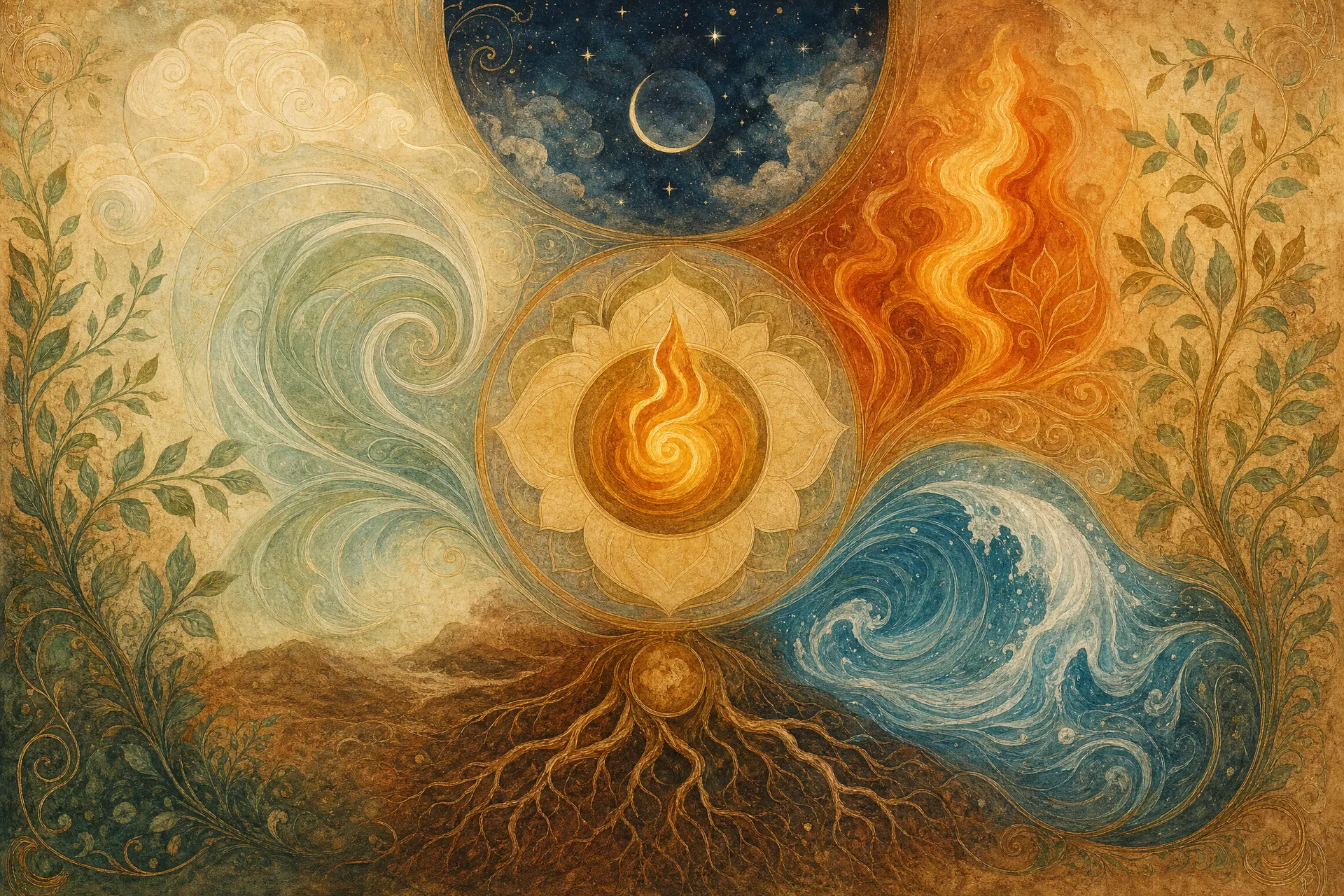
The Five Elements: Ether, Air, Fire, Water, and Earth — the living frequencies of the inner ecology.
Part III
The Art of Touch in Vitality Balancing
3.1 The Three Gunas: Qualities of Touch
Drawing from Ayurvedic philosophy and the Polarity Therapy tradition, Vitality Balancing teaches three qualities of contact: Sattvic, Rajasic, and Tamasic. [17] They are not a hierarchy and they are not a fixed sequence. They are adaptable ways of offering sensory, relational, and energetic information. The appropriate quality is determined by consent, intention, location, the client's response, and the practitioner's ongoing assessment.
Sattvic Touch
Light / Receptive / ListeningExperience and energetic metaphor: Sattvic contact is still or very slowly moving, with minimal pressure and no demand that the body change. It may feel spacious, quiet, subtle, or as though the system is being met without intrusion. Energetically, it invites coherence and allows the field to settle around its own centre.
Physiological lens: Gentle skin contact provides cutaneous and affective-touch information and may support subtle interoceptive awareness. When contact is welcome, predictable, and unhurried, it can reduce uncertainty and make small changes in breath, temperature, tone, and emotion easier to notice.
Light touch is not automatically calming. For some people it can feel ticklish, ambiguous, or unsafe, so pressure and location are negotiated.
Rajasic Touch
Rhythmic / Stimulating / MobilisingExperience and energetic metaphor: Rajasic contact includes rocking, shaking, brushing, friction, and guided or active movement. It may feel enlivening, warming, or like stagnant charge beginning to circulate. Energetically, it introduces movement where the system has become dull, fixed, or disconnected.
Physiological lens: Rhythm and movement provide changing cutaneous, proprioceptive, and sometimes vestibular information. They can increase movement variability, interrupt habitual bracing, and invite fuller participation.
Rhythm is not inherently regulating. Its speed, amplitude, and duration are dosed so activation becomes more organised rather than overwhelming.
Tamasic Touch
Firm / Grounding / DispersingExperience and energetic metaphor: Tamasic contact is broad, clear, and sustained rather than abrupt or forceful. It may feel containing, stabilising, or as though density is being met with sufficient presence. Energetically, it gathers scattered energy, meets Earth, and supports excess charge to distribute through the whole.
Physiological lens: Firmer pressure provides clearer pressure and proprioceptive information. In a context of consent and control, it may support body-boundary awareness and alter guarding, pain appraisal, and breathing.
Deeper is not better. Pressure that causes bracing, breath holding, numbness, or loss of orientation is reduced or stopped. The intention is not to force fascia to release, but to offer information that the person can use.
A session may weave all three qualities together. Sattvic contact can establish listening, Rajasic rhythm can invite mobilisation, and Tamasic contact can provide a clear boundary or ground. The practitioner may then return to Sattvic stillness for integration. The sequence remains responsive rather than formulaic.
Sattvic touch listens and invites. Rajasic touch mobilises and brings rhythm. Tamasic touch meets density with grounded clarity.Field note
3.2 Somatic Processing: From Holding to Harmonisation
Somatic processing is the conscious, paced exploration of present-moment bodily experience. In Vitality Balancing it includes sensation, breathing, posture, movement impulse, emotion, imagery, energetic experience, and meaning. The client is not a passive recipient. Their noticing, consent, movement, and choice are part of the method. [22] [23]
Held patterns are understood as whole-person organisations rather than objects trapped in tissue. A tight shoulder may involve local muscle tone, a guarded breath, an expectation of pain, an unfinished movement, an emotional association, a relational boundary, and an energetic experience of compression. Touch can help make this organisation perceptible and offer a different kind of input. Breathing, micro-movement, sound, orientation, and active participation can then help the pattern reorganise.
Harmonisation does not mean making every person calm or symmetrical. It means that physiological and energetic processes become more coordinated and the person has greater capacity to move between activation, rest, contact, and withdrawal without becoming stuck. A useful response may be softening, but it may also be a clearer no, a stronger boundary, more upright posture, or the energy to take action.
The practitioner tracks dose continuously. Signs that contact is within capacity may include continued orientation, easy speech, variable breathing, curiosity, and the ability to request a change. Signs to pause or reduce intensity include breath holding, escalating distress, blankness, disorientation, involuntary compliance, or a loss of choice. Vitality Balancing does not chase catharsis, provoke traumatic recall, or assign hidden meaning to bodily responses.
3.3 The Principle of Bipolar Contact
Bipolar contact uses two hands to connect different regions of the body within one field of awareness. In the traditional energetic map, the hands bridge positive, negative, and neutral poles and invite the vital force to complete a circuit. [18] Clients may experience warmth, pulsing, flow, softening, lengthening, or a sense of connection between previously separate areas.
The body's polarity is understood as follows. The right side of the body is generally considered positive (outgoing, active, solar), while the left side is negative (receptive, passive, lunar). The top of the body, particularly the head, is positive, while the bottom, particularly the feet, is negative. The front of the body is positive, while the back is negative.
By placing one hand on a positive pole and the other on a negative pole, the practitioner acts as a jumper cable, completing an energetic circuit. The vital force does the rest.Field note
From a somatic and physiological perspective, two-point contact provides simultaneous sensory information from distinct body regions. This may support body mapping, attention, boundary awareness, and coordination between breathing, posture, and movement. The practitioner observes and asks rather than assuming that every warmth, pulse, or emotion has a predetermined meaning.

The practitioner's hands create a circuit. The vital force completes the healing.
Part III (continued)
Core Hands-On Protocols
The following protocols represent the foundational techniques developed and taught in the Vitality Balancing curriculum from 1985 to 2004. They are designed to address systemic energetic dysregulation and can be adapted to the individual needs of each client.
Protocol 1: The North-South Axis
Spinal Balancing
Position
Client lies supine on a treatment table.
Contacts
- Contact 1 (Occiput): The practitioner sits at the head of the table and slides both hands, palms up, under the client's head. The fingertips rest at the base of the skull (the occipital ridge), cradling the cranium with a Sattvic touch.
- Contact 2 (Sacrum): The practitioner's forearm or a second practitioner's hand is placed under the sacrum (the triangular bone at the base of the spine).
Action, Experience & Somatic Lens
The practitioner holds the occiput and sacral region in still, receptive contact. Energetically, this connects the upper and lower poles of the central axis. Clients may report warmth along the spine, a spontaneous change in breathing, a sense of length, or a clearer connection between head and pelvis. Physiologically, predictable two-point contact may support orientation, body mapping, and changes in breathing or global muscle tone. These responses are possibilities, not guaranteed nervous-system outcomes. The practitioner checks comfort and does not claim to induce a specific vagal state.
Protocol 2: The Diaphragm Release
The Neutral Pole
Position
Client lies supine.
Contacts
- Contact 1 (Back): The practitioner places one hand, palm up, under the client's mid-back at the level of T12 to L1, where the diaphragm attaches to the spine.
- Contact 2 (Solar Plexus): The other hand rests gently on the solar plexus, just below the xiphoid process (the tip of the sternum), with a light Sattvic touch.
Action, Experience & Somatic Lens
The practitioner follows the client’s breathing and applies only the degree of contact that can be received without bracing. Energetically, the diaphragm is approached as a central place of movement between upper and lower fields. Somatically, the client may notice breath restriction, pressure, emotion, protective tension, or an impulse to move or sound. Physiologically, touch, attention, and paced exhalation may influence respiratory movement, abdominal and thoracic tone, and the appraisal of threat or support. A sigh or emotional response may occur, but is not pursued or interpreted as proof of stored trauma leaving the tissue.
Protocol 3: The Five-Pointed Star
Elemental Balancing
Position
Client lies supine.
Contacts
- Ether (Joints): The practitioner holds any two joints simultaneously — e.g., the wrist and the elbow — using a Sattvic touch. The space within the joint is the Ether element.
- Air (Shoulders and Calves): One hand rests on the top of the shoulder, the other cradles the calf muscle. A gentle Rajasic rocking of the calf is applied until the tension in the shoulder begins to soften.
- Fire (Solar Plexus and Thighs): One hand rests on the solar plexus, while the other offers clearly bounded Tamasic contact to the anterior thigh. This explores warmth, transformation, support, and hip-flexor holding without forcing change.
- Water (Chest and Pelvis): With explicit consent, one hand rests over the sternum and the other on the lower abdomen. This invites awareness of breathing, emotion, fluidity, and the relationship between chest and pelvis.
- Earth (Neck and Knees): One hand supports the cervical spine, the other rests behind the knee. A gentle Rajasic rocking of the knee is applied until the tension in the neck begins to soften.
Action, Experience & Somatic Lens
The practitioner connects the elemental reflex zones while adapting touch quality to the person’s response. Energetically, the sequence moves through Ether, Air, Fire, Water, and Earth to explore space, movement, transformation, cohesion, and grounding. Somatically, each pairing becomes an invitation to notice relationships between distant regions, breathing, posture, and movement. Physiologically, changing two-point sensory input may support body mapping and movement variability. The sequence is exploratory, not diagnostic proof of an elemental imbalance.
Protocol 4: The Cranial-Sacral Balancing
The Primary Axis
Position
Client lies supine.
Contacts
- Contact 1 (Occiput): The practitioner cradles the occiput with both hands, fingertips at the occipital ridge.
- Contact 2 (Sacrum): A second practitioner, or the same practitioner using a forearm, contacts the sacrum.
Action, Experience & Somatic Lens
The practitioner offers light, quiet contact at the occiput and sacral region and follows perceptible movement without imposing a rhythm. Clients may experience stillness, ease, warmth, subtle motion, or no distinct change. Energetically, the central axis is invited into greater coherence. Physiologically, gentle contact and reduced external demand may support attention to subtle sensation and breathing. Claims that a cranial rhythm stops and resets the nervous system are avoided; any perceived rhythm or still point is documented as practitioner or client experience.
Protocol 5: Foot Reflexology
The Part Contains the Whole
Position
Client lies supine or seated.
Contacts
- Contact 1 (Foot Reflex): One finger contacts a specific reflex point on the foot — e.g., the liver reflex on the right foot.
- Contact 2 (Organ): The other hand rests directly over the corresponding physical organ — the liver in the right upper quadrant of the abdomen.
Action, Experience & Somatic Lens
The practitioner connects a foot reflex area with the corresponding body region in the traditional map. Energetically, this is experienced as a relationship between the part and the whole. Somatically, two-point contact may help the client notice differences in sensation, tension, temperature, or movement between regions. Physiologically, the contact supplies pressure and attentional input, but it is not presented as direct treatment of an internal organ or proof of a specific reflex pathway.
Protocol 6: Aura Balancing
Off-Body Work
Position
Client lies supine or seated, fully clothed.
Contacts
- Assessment: The practitioner slowly moves their hands through the aura, approximately 2 to 6 inches from the body's surface, scanning for areas of excess heat, cold, congestion, or depletion.
Action, Experience & Somatic Lens
Off-body work is offered as an energetic and experiential practice, especially when direct touch is not wanted or would be too much. Clients may notice warmth, spaciousness, tingling, imagery, settling, or simply the effect of quiet attention and predictable movement around the body. The practitioner may describe perceived changes in the field while clearly identifying them as subjective observations rather than measurements of an anatomically verified structure. Consent and boundaries apply to off-body work as fully as they do to touch.
Part IV
Vitality Balancing within the 7 Domains of Inner Ecology
4.1 The Energetic Domain and Its Cross-Domain Connections
Within the IER framework, the Energetic Domain is the fifth of the 7 Domains, encompassing the vital force, meridian pathways, bioelectric fields, and biophoton emission. Signs of coherence in this domain include palpable vitality, physical warmth, fluid emotional energy, and resonance with beauty. Signs of disruption include persistent fatigue not resolved by rest, feeling "flat" or "deadened," chronic cold, and hypersensitivity to environments.
However, the Energetic Domain does not exist in isolation. It is in constant reciprocal relationship with all other domains. The gut microbiome produces neurotransmitters and short-chain fatty acids that directly influence the bioelectric environment of the nervous system. Energetic stagnation in the abdominal region, particularly in the Water and Earth elements, is often accompanied by gut dysbiosis and impaired immune function. The autonomic nervous system is the primary physical conduit of the vital force. Suppressed emotions are energetically dense — grief that is not expressed becomes a Water element blockage in the chest; anger that is not metabolised becomes a Fire element excess in the liver and solar plexus.
Direct contact with the Earth's surface electrons (earthing) has been shown to stabilise the internal bioelectrical environment, reduce inflammation, and improve vagal tone. [21] The Environmental Domain is the primary source of energetic replenishment. A deep sense of meaning and purpose — the Spiritual Domain — provides the coherence that organises all other biological and energetic processes. Without it, the vital force lacks direction and the system tends toward entropy.
4.2 The Five Regenerative Levers and Energetic Health
The Five Regenerative Levers of the IER system provide the primary mechanisms for restoring energetic coherence. Each lever has a direct energetic correlate in the Vitality Balancing framework.
Nervous System Regulation
Nervous system regulation supports the capacity to mobilise, rest, orient, connect, and protect without remaining fixed in one pattern. Vitality Balancing protocols may contribute through predictable contact, breathing, movement, attention, and relationship. Energetically, this may be experienced as contraction giving way to flow or coherence. Physiologically, effects vary between people and are not reduced to a guaranteed shift into a named vagal state.
Microbiome Restoration
Tends the 'inner soil' of the gut, which is the biological correlate of the Earth element. A healthy microbiome creates the stable, nourishing foundation from which all other energetic processes can flourish.
Circadian Alignment
Synchronises the body's bioelectric rhythms with the natural light-dark cycle. Morning sunlight exposure anchors the circadian clock and charges the cellular batteries, while evening darkness protects the production of melatonin, the hormone of regeneration.
Somatic Processing
Somatic processing helps a person notice and work with present-moment patterns of sensation, breathing, posture, movement, emotion, and energetic experience. The three qualities of touch offer different forms of information: Sattvic contact supports listening and subtle awareness, Rajasic contact invites rhythm and mobilisation, and Tamasic contact offers clarity, boundary, and ground. With consent and appropriate pacing, held patterns may soften or reorganise and physiological and energetic systems may become more coordinated. This is not the forced release of trauma from tissue. It is the development of awareness, choice, and adaptive capacity.
Meaning and Purpose
Provides the spiritual orienting force that organises all other biological coherence. A person who has found their purpose moves through the world with a different quality of energy — one that is coherent, directed, and vital.
Part V
Daily Practices for Energetic Self-Care
While the hands-on bodywork protocols are powerful clinical interventions, Vitality Balancing ultimately aims to empower the individual. As articulated in the naturopathic principle of Docere (Doctor as Teacher), the goal is to educate the client to become the steward of their own inner ecology. The principles of Vitality Balancing can be translated into daily self-care practices that regulate, clear, and harmonise the biofield.
Daily practice extends Somatics beyond the treatment table. The purpose is not continuous self-monitoring. It is to build a flexible relationship with sensation, movement, and energy so that useful signals can be noticed without becoming overwhelming or controlling.
Earth
Grounding
- •Walk barefoot on natural ground (grass, sand, soil) to allow free electrons to flow into the body, neutralising free radicals and reducing oxidative stress.
- •Visualise roots extending from the soles of your feet deep into the Earth, amplifying the grounding practice by engaging the imagination as an energetic tool.
- •Practice slow, resonant breathing at approximately 5 to 6 breaths per minute to directly increase vagal tone and anchor the nervous system in the present moment.
Earthing has been shown to stabilise the internal bioelectrical environment, reduce inflammation, and shift the autonomic nervous system toward parasympathetic regulation.
Air + Fire
Cleansing
- •Move the arms freely, shake the body, or engage in vigorous dance to circulate stagnant chi, increase movement variability, and interrupt habitual tension.
- •Use strong exhales, particularly with sound (a sigh or a groan), to release accumulated tension from the nervous system and the diaphragm.
- •Clear the physical environment using sound bowls, sage, or simply opening windows and allowing fresh air to circulate.
The Air element governs movement and the Fire element governs transformation; together they provide the energetic metabolism needed to process and release what no longer serves.
Ether
Centering
- •Orient first: notice three things you can see, two sounds, and the support beneath you.
- •Track one neutral or pleasant sensation, such as warmth in the hands, contact at the feet, or the movement of one breath.
- •Let attention move between the sensation and the external room. This supports choice and prevents inward attention from becoming too intense.
- •Experiment with a small movement, sound, or change of posture and notice whether the body feels more organised, less organised, or unchanged.
- •If imagery such as roots, light, or an elemental quality is helpful, use it as an experiential resource rather than a literal physiological claim.
Centering creates spaciousness for the vital force to organise the system while somatic tracking develops awareness without demanding continuous inward attention.
Water + Fire
Charge & Vitalise
- •Practice alternating nostril breathing (Nadi Shodhana) to balance the left and right hemispheres of the brain and harmonise the positive and negative energetic poles.
- •Engage in Qigong or Tai Chi to cultivate the vital force by moving energy through the meridian pathways in a slow, conscious, and intentional manner.
- •Seek morning sunlight exposure to anchor the circadian clock and charge the cellular batteries; rest in nature to replenish the Water element.
These practices build resilience by actively charging the vital force and cultivating the body's capacity for sustained energetic output.
Part VI
Signs of Energetic Coherence and Clinical Outcomes
6.1 Observable Markers of a Balanced Biofield
Coherence is assessed through patterns of function and experience rather than a single claim that the biofield has been aligned. Useful markers may include easier breathing, more variable and comfortable movement, clearer boundaries, improved orientation, reduced guarding, greater emotional range, a steadier sense of energy, and the capacity to act in daily life. These markers are interpreted in the client's context and are not proof of one underlying mechanism.
Easier, more variable breathing and a greater capacity to remain oriented and engaged.
More comfortable movement, reduced unnecessary guarding, and a wider range of postural choices.
Clearer boundaries and embodied confidence, experienced energetically as a stronger Earth quality.
Greater emotional range with the capacity to feel, express, and settle without becoming fixed in one state.
A steadier sense of energy, clearer decision-making, and greater participation in daily life.
Clients frequently report that, following a series of Vitality Balancing sessions, they begin to make decisions from a deeper place of knowing, informed by the body's wisdom rather than the mind's anxiety.
6.2 The Therapeutic Relationship as a Regulatory and Energetic Field
The therapeutic relationship is part of the intervention. The practitioner's pace, tone of voice, clarity, reliability, consent process, and quality of attention all influence how contact is received. Energetically, this may be experienced as resonance, spaciousness, containment, or disruption. Physiologically, social and sensory context can alter attention, expectation, muscle guarding, breathing, and the appraisal of safety or threat.
The practitioner is, in a very real sense, the primary therapeutic instrument. The cultivation of the practitioner's own inner ecology is not a luxury. It is a clinical necessity.Field note
This does not mean that a practitioner mechanically transmits a particular nervous-system state to a client. Co-regulation is relational and reciprocal, not a one-way transfer. Practitioners cultivate their own grounding, notice when they are trying to make something happen, and return authority to the client's experience. Presence is therefore a clinical discipline as well as an energetic quality.
Conclusion
The Living Intelligence of the Ecosystem We Are
Vitality Balancing works at the meeting place of physiology, lived experience, energy, and relationship. Rooted in Polarity Therapy and renewed through the Inner Ecology Repatterning™ framework, it offers a coherent approach to touch, awareness, and whole-person participation without requiring one language to cancel another.
The three qualities of touch give practitioners a refined vocabulary for this meeting place. Sattvic touch listens and invites. Rajasic touch mobilises and brings rhythm. Tamasic touch meets density with grounded clarity. Used with consent, pacing, and humility, they create conditions in which held patterns may soften, reorganise, and rejoin the living whole.
The vital force is not a metaphor. It is the living intelligence of the ecosystem that we are.Field note
Energetic experience can be honoured as flow, charge, release, and harmonisation. Physiological explanation can describe touch as sensory information interacting with breathing, movement, attention, autonomic regulation, pain, expectation, and meaning. Vitality Balancing is strongest when both are spoken clearly and neither is confused with certainty.
The body is not treated as broken, passive, or waiting to be corrected. It is approached as a living, adaptive system capable of learning, protection, relationship, and change. The practitioner's role is to listen, offer appropriate information, and support the person towards greater choice, coherence, and participation in life.
References
- [1]Inner Ecology Repatterning™: 7 Domains of Inner Ecology.
- [2]Vitality, vital force and natural medicine. Available online ↗
- [3]Inner Ecology Repatterning™: 9 Principles of Wholistic Naturopathy.
- [4]The Life and Legacy of Samuel Hahnemann. PMC, 2024. Available online ↗
- [5]Rubik, B., Muehsam, D., Hammerschlag, R., & Jain, S. (2015). Biofield Science and Healing: History, Terminology, and Concepts. Global Advances in Health and Medicine, 4(Suppl), 8–14. Available online ↗
- [6]The Chakras And The Nervous System. Creative Soul Therapies. Available online ↗
- [7]Biofield Physiology: A Framework for an Emerging Discipline. PMC, 2015. Available online ↗
- [8]An introduction to human biophoton emission. PubMed. Available online ↗
- [9]Polyvagal Theory: Current Status, Clinical Applications, and Future Directions. PMC. Available online ↗
- [10]Somatic experiencing: Using interoception and proprioception as core elements of trauma therapy. Frontiers in Psychology. Available online ↗
- [11]Levine, P. A. (1997). Waking the Tiger: Healing Trauma. North Atlantic Books.
- [12]Inner Ecology Repatterning™: 5 Levers of Regenerative Wellness.
- [13]Polarity Therapy. Institute of Noetic Sciences. Available online ↗
- [14]The History of Polarity Therapy. Larry Witzleben. Available online ↗
- [15]Polarity Therapy: A Comprehensive System In The Energy-Based Healing Arts. Wellness Institute. Available online ↗
- [16]Five Elements of TCM vs Ayurveda for Health, Healing & Wellness. Amit Ray. Available online ↗
- [17]Korn, L. E. & Ryser, R. C. (2006). Designing a polarity therapy protocol. Journal of Bodywork and Movement Therapies. Available online ↗
- [18]Deavin, A. (2007). Polarity Therapy: Touch with Awareness. Positive Health Online. Available online ↗
- [19]Polarity therapy protocol for dementia caregivers. ScienceDirect. Available online ↗
- [20]Seidman, M. (2000). A Guide to Polarity Therapy: The Gentle Art of Hands-on Healing. North Atlantic Books.
- [21]Chevalier, G., Sinatra, S. T., Oschman, J. L., Sokal, K., & Sokal, P. (2012). Earthing: health implications of reconnecting the human body to the Earth's surface electrons. Journal of Environmental and Public Health. Available online ↗
- [22]Khalsa, S. S., et al. (2018). Interoception and Mental Health: A Roadmap. Biological Psychiatry: Cognitive Neuroscience and Neuroimaging. Available online ↗
- [23]Quadt, L., Critchley, H. D., & Garfinkel, S. N. (2018). The neurobiology of interoception in health and disease. Annals of the New York Academy of Sciences. Available online ↗
- [24]Olausson, H., et al. (2010). The neurophysiology of unmyelinated tactile afferents. Neuroscience & Biobehavioral Reviews. Available online ↗
- [25]Ackerley, R., et al. (2014). Human C-tactile afferents are tuned to the temperature of a skin-stroking caress. Journal of Neuroscience. Available online ↗
- [26]Diego, M. A., et al. (2009). Moderate pressure massage elicits a parasympathetic nervous system response. International Journal of Neuroscience. Available online ↗
- [27]Buttagat, V., et al. (2011). Immediate effects of traditional Thai massage on heart rate variability and stress-related parameters. Journal of Bodywork and Movement Therapies. Available online ↗
- [28]Kuhfuß, M., et al. (2021). Somatic Experiencing: effectiveness and key factors of a body-oriented trauma therapy. European Journal of Psychotraumatology. Available online ↗
- [29]Brom, D., et al. (2017). Somatic Experiencing for Posttraumatic Stress Disorder: a randomized controlled outcome study. Journal of Traumatic Stress. Available online ↗
- [30]Tozzi, P. (2014). Does fascia hold memories? Journal of Bodywork and Movement Therapies. A theoretical and controversial proposition rather than established evidence. Available online ↗
Evidence interpretation: Research on touch, massage, autonomic measures, and body-oriented trauma approaches is heterogeneous. These references support plausible pathways and careful clinical hypotheses. They do not prove that a specific Vitality Balancing contact causes a particular autonomic state, releases trauma from fascia, or directly moves an anatomically verified energy field.